
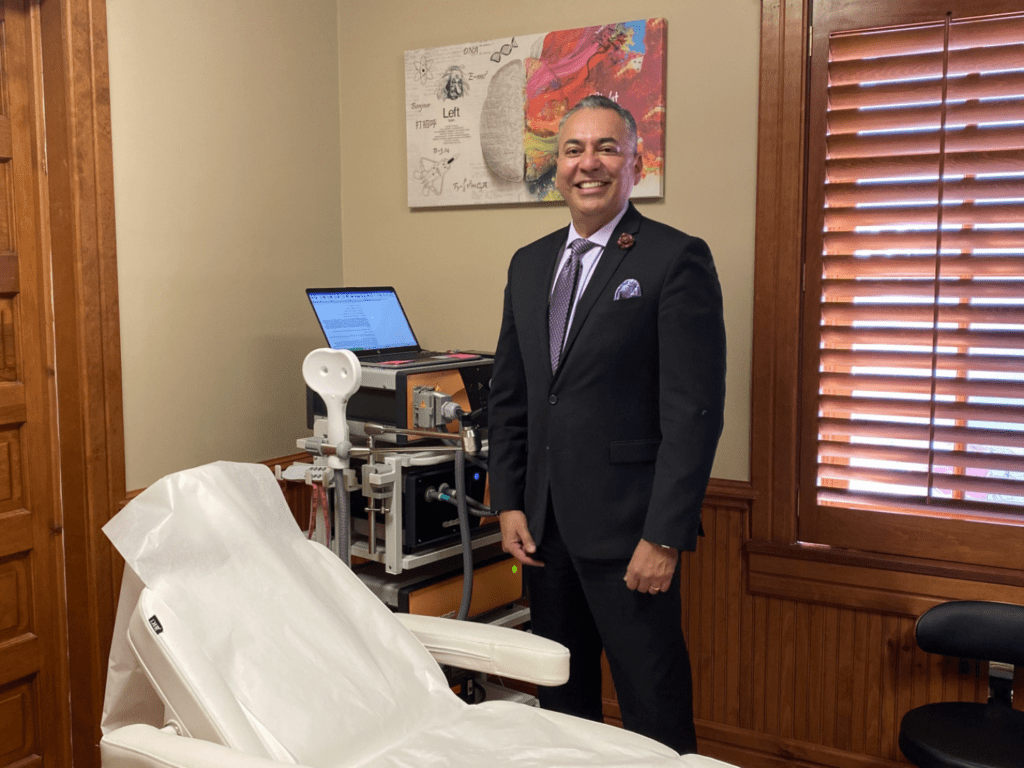
Quick answer: Your first TMS session starts with a brief mapping process to find the correct treatment location and pulse intensity for your brain, followed by a short test session. Most first appointments take longer than later ones — usually 30 to 60 minutes — while follow-up sessions are typically much shorter. You’ll be awake, seated comfortably, and able to drive yourself home immediately afterward.
If you’ve decided to move forward with TMS therapy, it’s completely normal to feel a mix of relief and nerves about that first appointment. Knowing exactly what to expect can make the process feel a lot less unfamiliar.
Before Your First Session: Mapping and Dosing
Your very first TMS visit isn’t quite like the sessions that follow. Before treatment begins, your provider needs to determine two things specific to you: the exact location on your scalp that corresponds to the target region of your brain, and the right pulse intensity, called your “motor threshold.”
To find your motor threshold, your provider will deliver a series of test pulses to a specific part of your head while watching for a small, involuntary movement in your thumb or hand. This tells them the minimum intensity needed to stimulate your brain’s motor cortex, which is then used to calculate the correct treatment intensity for your depression-focused sessions. This mapping process is quick, painless beyond the tapping sensation, and only needs to be done again if your device settings change significantly.
What Happens During the Session Itself
Once your treatment location and settings are established, you’ll be seated in a comfortable treatment chair, similar to a recliner. Your provider positions the TMS coil against your scalp and begins delivering the pulses according to your specific treatment protocol.
Here’s what you’ll experience:
- A tapping or knocking sensation on your scalp where the coil is positioned, along with a clicking sound from the device
- No sedation — you’re fully awake and alert the entire time
- The ability to relax, listen to music, or simply sit quietly during the session, depending on your provider’s setup
- A treatment time that varies depending on the specific TMS protocol used, ranging from a few minutes for newer accelerated protocols to about 20-40 minutes for traditional protocols
Common Sensations and How to Manage Them
Some patients notice mild scalp discomfort, tightness, or a mild headache during or after their first few sessions. This is common, especially early in treatment, and tends to decrease as your brain and scalp acclimate. Over-the-counter pain relief, taken as advised by your provider, can help in the first week or two if needed. If discomfort doesn’t improve or feels significant, let your provider know — they can adjust settings to make sessions more comfortable.
After Your Session
One of the most reassuring things about TMS is what happens after: nothing dramatic. There’s no recovery room, no grogginess, and no restriction on driving. Most patients go straight back to work, school, or the rest of their day immediately after each appointment.
What the Full Course of Treatment Looks Like
A typical TMS course involves sessions five days a week for roughly four to six weeks, though your provider will set your specific schedule and protocol. Consistency matters — TMS works cumulatively, meaning the benefit builds over the course of treatment rather than from any single session.
Tracking Your Progress
Throughout your treatment course, your provider will check in regularly on your symptoms, often using standardized questionnaires to track objective changes in your depression severity over time. This isn’t just a formality — it helps your care team confirm the treatment is working and make adjustments if needed.
Building TMS Into Your Weekly Routine
Because a full TMS course typically means daily sessions on weekdays for several weeks, planning ahead makes the process considerably easier. Many patients schedule their sessions around a consistent time of day — first thing in the morning before work, over a lunch break, or at the end of the day — to build treatment into their existing routine rather than treating each appointment as a separate disruption. Since sessions don’t involve sedation or downtime, most patients find that once a rhythm is established, TMS fits into daily life more easily than they initially expected.
If your schedule is unpredictable, it’s worth discussing this directly with your provider’s office before starting treatment. Some practices, including those with multiple locations, may be able to offer flexibility in scheduling to help you stay consistent throughout the full course.
Bringing Someone With You (or Not)
Because TMS doesn’t involve sedation, you’re not required to have someone drive you to or from your appointments, unlike some other psychiatric treatments such as Spravato. That said, some patients — especially during their first few sessions — appreciate having a support person along simply for reassurance. Whether you come alone or bring someone with you is entirely a matter of personal preference.
Communicating with Your Provider Throughout Treatment
Your relationship with your treatment team doesn’t stop once your protocol is set. If you’re experiencing more discomfort than expected, noticing changes in your mood between sessions, or simply have questions as treatment progresses, that’s worth bringing up rather than waiting until your course is complete. TMS protocols can sometimes be adjusted mid-course — for example, if scalp discomfort is more significant than expected — so ongoing, honest communication with your provider is part of what makes treatment effective.
Frequently Asked Questions
Can I drive myself home after a TMS session?
Yes. TMS doesn’t involve sedation, so you’re able to drive, return to work, or resume your normal schedule immediately after each session.
How long is the first TMS appointment compared to later ones?
Your first appointment typically takes longer — often 30 to 60 minutes — because it includes the mapping and dosing process. Follow-up sessions are generally quicker, depending on the specific protocol your provider uses.
What if I feel nothing during the session — does that mean it’s not working?
No. The tapping sensation and clicking sound confirm the device is delivering pulses, but the therapeutic effect builds gradually over the full course of treatment rather than being felt session to session.
Can I go back to work immediately after a TMS session?
Yes. Since there’s no sedation or recovery period, most patients return directly to work, school, or their normal activities right after each appointment.
What happens if I miss a session?
Occasional missed sessions can usually be accommodated by adjusting your schedule, but consistency matters for TMS to work as intended. Talk to your provider’s office as soon as possible if you need to reschedule, so your treatment plan can be adjusted accordingly.
This article is for informational purposes only and is not a substitute for a professional psychiatric evaluation